We never fully grow up. At least not in the way we’d like to believe. Within all of us, is an inner-child that always has something to feel or say. The question is, do we listen? Children learn in two amazing ways; through experience and play. For adults who want to keep learning and growing, connecting with our inner-child creates the space to “un-learn” the habits and behaviours that are not helping us grow to our potential.
For some though, reconnecting with the inner-child might also require facing some difficult emotions. The place those difficult emotions came from as children, can sometimes create fragments in ourselves and prevent open learning and adaptation as adults. That’s where inner-child work comes in.
What is inner child work?
The inner child can be defined as the impressionable and vulnerable part of ourselves wounded and shaped throughout the earliest experiences and stages of our lives. Inner child work is an approach to recognizing and healing childhood wounds. It recognizes that our behaviours as adults stem from our childhood experiences. It focuses on addressing our unmet needs by reparenting. This kind of self-discovery helps us understand our behaviours, triggers, wants, and needs.
Imagine that you’re 5 years old. You’re playing and having the best time when an adult tells you “stop being over-bearing”. Your 5-year-old mind doesn’t know the meaning of the phrase, but you internalize the harshness of having fun is bad or maybe being yourself is distasteful. Or imagine you’re 7 years old and you tripped and fell, scraping your knee in the process and cried in front of your friends at school. They laughed and called you a baby.
The details of the event may evade you, but you internalized the feeling of shame or humiliation. You may even remember thinking how you’d never want to make a fool of yourself again. It’s one of those cringe-worthy thoughts.
While the outer scars may have healed, you’re unconsciously carrying the weight of the pain of that inner-wounding. This wounding doesn’t show up as we’d imagine. It’s unpredictable and relative to every situation, but let’s imagine the 5 year-old that was told not to be over-bearing. She internalizes a belief that when she shows up as herself in life, people don’t like it. And because of the brain’s confirmation bias, the brain will keep producing all kinds of evidence to support that belief, no matter how untrue it is. As an adult, she sabotages her work or relationships, procrastinates and doesn’t feel safe to be “seen” as she is, because of an ingrained belief of a wounded inner-child. Or the knee-scraped 7- year-old that grows up to believe that emotions are for babies and showing any will make her weak. That’s completely disempowering, but sadly the reality for many people that are unconsciously being governed by wounded inner-parts.
Inner-child work allows us to tap into a part of ourselves that is vulnerable and impressionable. We’re able to be both the “grown-up” and the child, providing unconditional self-love, self-compassion and self-support.
What causes a wounded inner child?
There isn’t a “if this, then that” approach to wounding. What may have traumatized me as a child may not have the same impact on you. Our nervous systems and thinking patterns are wired differently, so, truth be told, an infinite number of situations can cause a wounded inner-child. Think back to when you were younger. Some hurts were relatively small. And for some, “hurt” may have been the result of physical abuse or emotional neglect.
It’s impossible to list all the conditions your younger self may have internalized. However, it’s likely that if you do have inner-child wounding, the effects are evident in your life today. Here are some signs that your inner child needs healing:



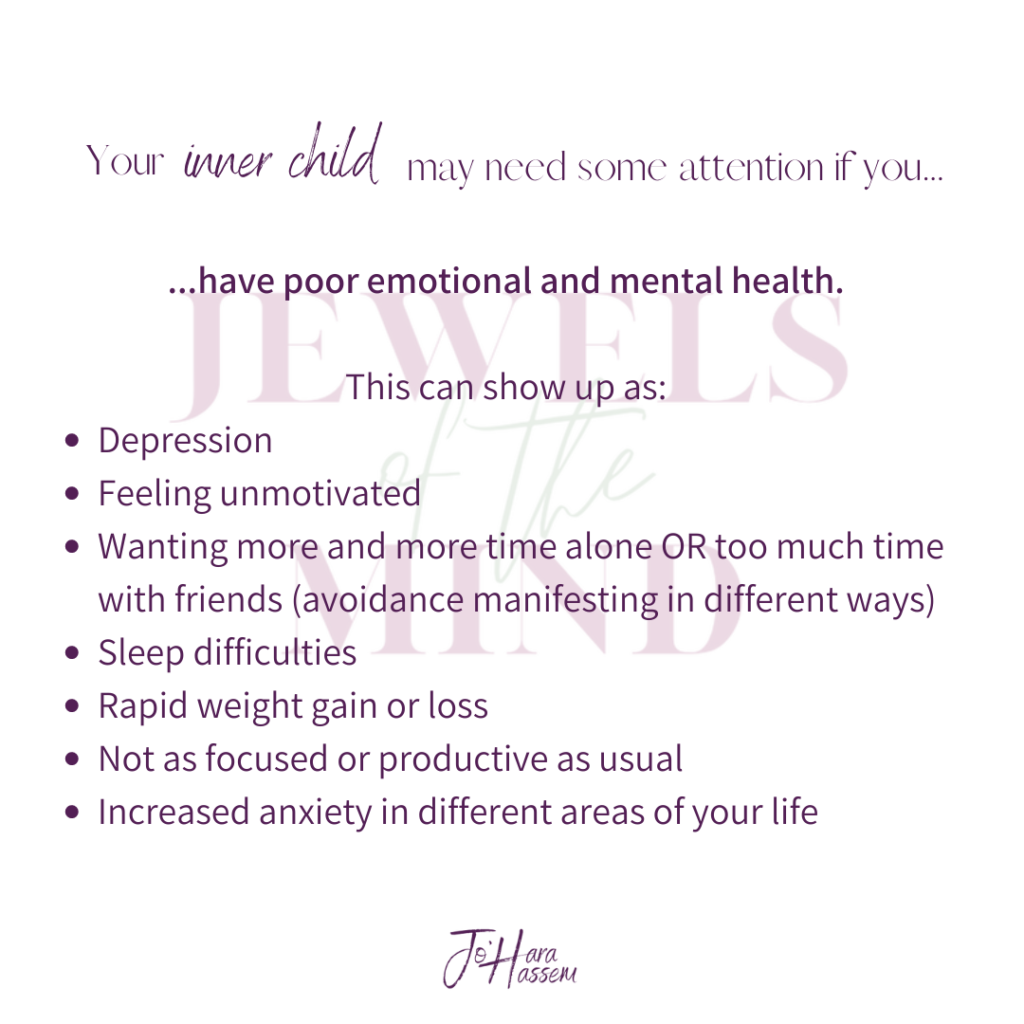
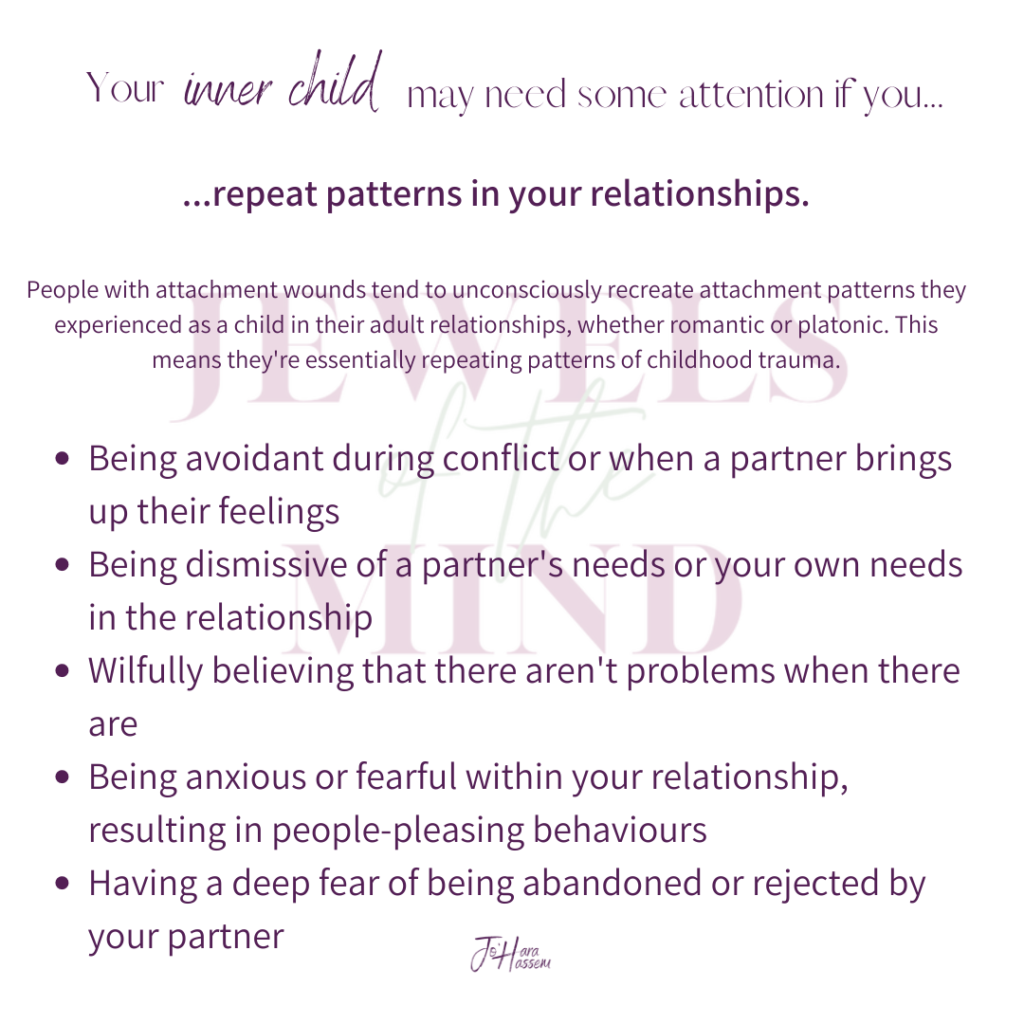
If you recognize any of these patterns in yourself, childhood wounds might be the reason. Seeing the ways that your inner-child needs support can help you resolve these patterns as an adult.
What does healing your inner child mean?
When you begin working to heal your inner-child, you sort of go back in time — emotionally and mentally. It’s a process that isn’t limited to a single occasion or event but can be a multitude of moments that you refer to. It empowers you to understand how your inner-child feels from the perspective of an adult. With that, your adult self can start to untangle the coping mechanisms your younger self came up with to protect you from further hurt.
Benefits of inner child work:
The foundational benefit of inner child work is building self-awareness, which is done by developing the skill of introspection. It’s no wonder that personal growth and inner-work go hand-in-hand because going within is really the foundation of personal growth.
Building a healthy self-awareness opens the gates of:
- Understanding how past trauma affects your present behaviour
- Developing healthy coping mechanisms
- Reconnecting to passions, dreams, and talents you may have put aside
- Feeling empowered and in control of your life
- Improved emotional regulation
- Increased self-esteem, self-compassion, and compassion for others
How to start inner child work?
We can’t go back and change the past, but we can choose not to let the past have a grip on us in this present moment. I know all this might be much to process, but it’s really not difficult to start healing. Here’s where it gets hands-on:
- Start noticing yourself more
When you get upset, frustrated, or feel emotional discomfort, start noticing what’s happening around you and within your body. Paying attention to these triggers can help you connect them to childhood wounds.
There are other significant ways to listen to yourself. Part of developing self-awareness is practicing self-care. Find a self-care routine that feels the most uplifting to you. Taking care of your own needs can be a powerful act of self-love that’s very nurturing for your inner-child.
2. Journaling
Journaling has a lot of benefits, including the safe, private space to decompress difficult emotions. But journaling can also be used to explore the inner-child.
Try using journal prompts to get curious about your inner-child. You could ask questions like:
- What did you do for fun as a child?
- What did you want to be when you grew up?
- What did you daydream about when you were a child?
- Who was your childhood hero? What about them did you love?
- Who were your closest friends growing up? What did you like about them?
- Who were your favourite teachers and why?
- When you were a kid, how did you imagine your life would be as a grown up?
- Write about a time when you felt scared
- What is your first memory?
- Describe a time when someone hurt your feelings
- Write about a time when you hurt someone else’s feelings as a child.
- How do you deal with emotional discomfort?
Get really creative with your questions and write freely, without judgement. Be honest, and keep a look out for any themes or patterns you notice while you journal.
3. Speak through artistic or creative expression.
Connecting creatively may seem juvenile, but is really therapeutic in itself. Painting, colouring and drawing are just a few examples, where in reality there are countless more. Get creative, get messy. Do it barefoot if that feels good.
Ultimately, you’d want to connect with your inner-child in a way that feels most authentic to you. Working with a coach, therapist or counsellor, can help you define a good strategy for inner-child work.